GCU Nursing Clinical & Practicum Hours, Explained
If you’re mapping out a Grand Canyon University nursing program, the clinical hour requirement is one of the most important numbers to understand early. This guide breaks down how many supervised hours each GCU nursing track requires, what the practicum structure looks like, and where the on-campus immersions fit in, so you can plan ahead and avoid the delays that catch many students off guard.
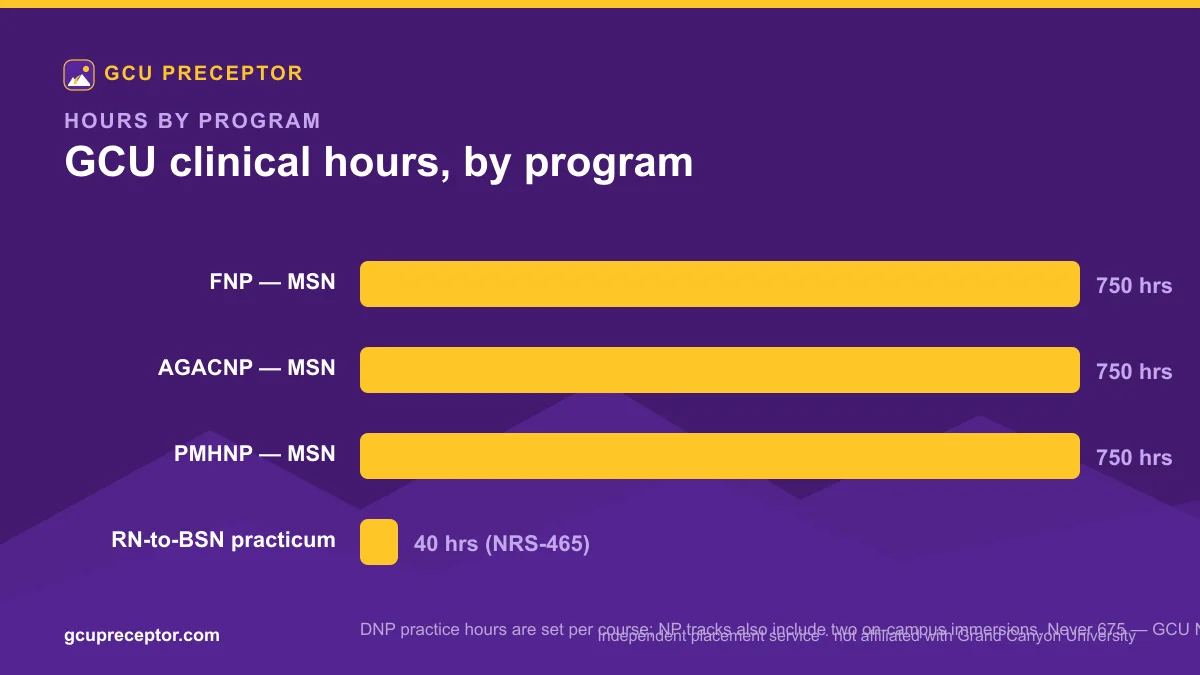
How many clinical hours do GCU MSN nurse practitioner students need?
All three of Grand Canyon University’s MSN nurse practitioner tracks share the same core clinical requirement: 750 hours of directly supervised clinical practice with qualified preceptors. This applies equally to the Family Nurse Practitioner (FNP) track, the Acute Care Nurse Practitioner, Adult-Gerontology (AGACNP) track, and the Psychiatric Mental Health Nurse Practitioner (PMHNP) track. Each of these tracks is built around 53 credits, and the 750-hour standard is consistent across all three.
Where the tracks differ is in the type of clinical setting where those hours are earned. FNP students typically complete their hours in local primary and family care settings. AGACNP students work in acute care environments. PMHNP students complete their supervised practice in psychiatric and mental health settings. The total hour requirement stays the same, 750, but the clinical site you’ll need to secure depends on your specialty.
The 750-hour requirement at a glance
- FNP (Family Nurse Practitioner), 53 credits, 750 supervised hours, local primary/family care sites
- AGACNP (Acute Care NP, Adult-Gerontology), 53 credits, 750 supervised hours, acute care sites
- PMHNP (Psychiatric Mental Health NP), 53 credits, 750 supervised hours, psych/mental health sites
How the 750 hours are structured across the program
Rather than completing all 750 hours at once, GCU NP students generally earn their clinical hours across a sequence of practicum courses throughout the program. The exact number of practicum courses and the per-course hour breakdown can vary by track and catalog year, so we’d encourage you to confirm those details directly against GCU’s current program pages.
Spreading the hours across multiple courses means you’ll need a qualified preceptor and an approved clinical site lined up for each practicum phase, not just once at the start. This is exactly where many students run into trouble, because preceptor availability has to be confirmed well before each practicum course begins. Planning each placement ahead of time, rather than scrambling at the last minute, is the single biggest factor in staying on schedule.
You can read more about how site approval works on our Office of Field Experience page, and learn what makes a preceptor eligible on our preceptor requirements guide.
On-campus immersions: why GCU NP programs aren’t entirely online
A common misconception is that GCU’s online NP programs are completed entirely from home. They are not. In addition to the 750 supervised clinical hours, all three MSN NP tracks include two on-campus immersion experiences, one lasting 3 days and one lasting 2 days. These immersions are a required part of the program and involve traveling to campus, so it’s worth building them into your timeline and budget from the beginning.
The immersions are separate from your clinical practicum hours. They don’t replace the 750 supervised hours, and the 750 hours don’t replace the immersions, you’ll need to complete both to finish your track.
Clinical and practicum hours for other GCU nursing programs
The 750-hour standard applies specifically to the MSN NP tracks. Other GCU nursing programs have their own, very different field requirements:
Post-Master’s APRN certificates. GCU offers post-master’s certificates in FNP, AGACNP, PMHNP, and Nursing Education. The post-MSN FNP certificate is 37 credits and includes a 750-hour supervised clinical practicum. Exact credit and hour figures for the AGACNP and PMHNP certificates aren’t something we’ll state here as fact, please verify those against GCU’s current program pages.
DNP (Doctor of Nursing Practice). GCU’s DNP is 39 credits, delivered in online 8-week courses with synchronous activities such as project defenses, and is suited to students who already hold an MSN in nursing. The capstone is a Direct Practice Improvement (DPI) Project completed across three phases, development, implementation, and evaluation, including IRB preparation, data collection, and dissemination. DNP practice/practicum hours exist at the course level, but they shouldn’t be combined into a single headline total; check the per-course requirements on GCU’s pages. You can see more on our DNP practicum page.
RN-to-BSN. GCU’s RN-to-BSN is an online program of 120 credits with 5-week courses and a core that can be completed in roughly 14 months. The field requirement here is modest: NRS-465, “Applied Evidence-Based Project and Practicum,” which involves 40 clinical hours arranged locally. We cover this in more detail on our RN-to-BSN practicum page.
Pre-licensure BSN and ABSN. GCU’s campus BSN and hybrid Accelerated BSN programs publish per-course clinical hours. Because these are listed course by course, we don’t publish a single summed total, refer to GCU’s program pages for the specifics.
A note on how GCU placements actually work
GCU’s Office of Field Experience (OFE) and its field experience specialists support the placement process, they help with the application, confirm health and safety requirements, and ultimately approve the clinical site you select so it meets practicum standards. But here’s the part that surprises many students: GCU generally expects you to identify your own preceptor and clinical site. The university supports and approves placements; it does not place, assign, or secure preceptors for you.
That responsibility, finding a qualified preceptor and a site GCU will approve, for each practicum, is the gap that delays so many NP students from graduating. Preceptor spots fill up fast, and missing a window can push your timeline back by a full term.
How we help GCU students hit their clinical hours on time
gcupreceptor.com is an independent, third-party preceptor and clinical-placement support service for GCU nursing students. We are not affiliated with or endorsed by Grand Canyon University. What we do is help you secure a qualified preceptor and a clinical site you can submit for GCU’s approval, so you can complete your 750 supervised hours without losing a semester to a placement search.
We offer physical placement matching for in-person clinical hours, plus a virtual practicum service for telehealth and remote scenarios where applicable. We assist with the search; we don’t guarantee placement, outcomes, or that GCU will approve any particular site; that approval always rests with GCU’s OFE.
If you’d like help lining up your preceptor before spots fill, see how it works or find a preceptor. You only pay when you’re matched.
Frequently asked questions
How many clinical hours does a GCU nurse practitioner program require?
All three of GCU’s MSN NP tracks, FNP, AGACNP, and PMHNP, require 750 hours of directly supervised clinical practice with qualified preceptors. Each track is 53 credits, and the 750-hour requirement is the same across all three.
Are GCU’s online NP programs entirely online?
No. In addition to the 750 supervised clinical hours, all three MSN NP tracks include two on-campus immersion experiences, one 3-day and one 2-day, so the programs are not entirely online.
How many clinical hours does the GCU RN-to-BSN require?
The RN-to-BSN field requirement is NRS-465, “Applied Evidence-Based Project and Practicum,” which involves 40 clinical hours arranged locally. It’s a much smaller field component than the NP tracks.
Does GCU find my preceptor for me?
Generally, no. GCU’s Office of Field Experience supports the application, confirms health and safety requirements, and approves the site you select, but students are typically responsible for identifying their own preceptor and clinical site. That’s the gap our independent service helps fill.
How are the 750 NP clinical hours structured?
GCU NP students generally earn the 750 hours across a sequence of practicum courses rather than all at once. The number of courses and the per-course hour breakdown can vary by track and catalog year, so we’d encourage you to confirm the current structure directly with GCU.
Get your GCU clinicals handled.
Tell us your track and term. We’ll map your clinical requirement and start the search, in person or virtual. No payment until you’re matched.